3.5 Mixtures more chromatic than both parents
The painting literature states a firm rule: “the mixture of two paints will always be duller than the more saturated paint” [48]. For a colored paint and white the rule is wrong, and measurements show it. The tint peak of Section 3.4 is a mixture more vivid than both of its parents: in Okumura’s ladders dioxazine goes from a chroma of 3 in masstone to 46 with white, while the white itself has a chroma of about 1 [59]. A pale paint that behaves like a white, such as titan buff, does the same in the model, as the third pair in Figure 17 shows. Between two colored paints no exception has been measured, and the model finds only small ones.
The averaging of K/S leaves two ways for a mixture to come out more vivid than either paint, and the math box at the end of this lesson follows both in symbols. The first is to clean up stray light. A paint is dulled when it reflects some light outside its main band, the stretch of the spectrum it is meant to reflect. Chromium oxide green is an example: it reflects its green band at about a fifth of the light, and it also leaks a little violet at one end of the spectrum and a little red at the other, which keeps its color muted. A small amount of a partner that is dark at both ends and passes the green could darken the leaks more than it darkens the band. The second way is to brighten the main band. A partner that reflects the main band better than the first paint does lifts it, while each paint’s absorption holds down the colors the other lets through. White is the extreme case of this second way, a partner with almost no absorption, and the only one measured to work.
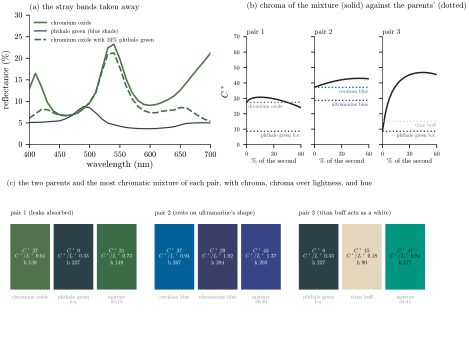
Figure 17. A mixture more vivid than both parents, as the model computes it. (a) The reflectance of chromium oxide, of phthalo green (blue shade), and of chromium oxide with ten percent phthalo green: the leaks at both ends are removed and the green band is kept. (b) Chroma along the mixing line of each pair, one panel per pair, with the two parents’ own chroma dotted. (c) The parents and the most vivid mixture of each pair, with their chroma and hue.
With two colored paints both ways are narrow. A mixture’s K/S at every wavelength lies between the two paints’ own, so a partner cannot darken the leaks without darkening the main band too, unless it is nearly black outside the main band and passes the main band almost as well as the first paint does. That describes a dark transparent paint of the same or a neighboring hue. Real pigments absorb across broad stretches of the spectrum, so even the best partner takes some of the main band along with the leaks. Two paints from opposite sides of the hue circle can take neither way, because each absorbs the other’s main band.
In the model the first way works, though only a little. Ten percent of phthalo green (blue shade), a paint that is nearly black except for a narrow band of blue-green, cuts the leaks of chromium oxide at both ends to half or less and hardly touches its green band, and the chroma rises from 27 to 31 (Figure 17(a)). With more phthalo the chroma falls again, as the phthalo’s own blue-green takes over. Across all the pairs of calibrated paints, leaving titan buff aside, only a handful beat both parents by a unit of chroma or more, and none by more than six. The largest, cerulean blue with ultramarine at equal parts, would work the second way, but it rests on how ultramarine’s scattering is spread across the spectrum, which its tint ladder does not settle (Section 2.6). Read the ladder another way that fits it about as well, and the gain all but disappears.
Gains this small are within the model’s error. When Okumura tested the same kind of model on mixtures of two paints, its predictions were off by about two units of color difference on average and by as much as eight (Section 2.6) [59], as large as the gains themselves, and none of the gains has been measured. With white the exception to the rule is real and large. Between two colored paints, the model allows small exceptions that no one has shown in real paint.
Sources
[48] B. MacEvoy, handprint: colormaking attributes, color vision, the geometry of color perception, modern color models, color temperature, color wheels, the pigment guides, https://www.handprint.com/HP/WCL/wcolor.html, 1998–2023.
[59] Y. Okumura, Developing a Spectral and Colorimetric Database of Artist Paint Materials, M.S. thesis, Rochester Institute of Technology, 2005, https://repository.rit.edu/theses/4892.