2.4 Transparent and opaque pigments
A paint is opaque if a thin layer of it hides what is under it, and transparent if the ground shows through, and scattering decides which. Light entering an opaque paint is turned around within a short distance by the pigment particles and comes back out before it ever reaches the ground; light entering a transparent paint goes through to the ground, is reflected there, and comes back through the paint, so what you see is the ground seen through a colored filter. Opaque pigments are usually inorganic, minerals and metal compounds whose particles have a high refractive index and are near the size that scatters best: the cadmiums, the iron oxides, chromium oxide, titanium white. Transparent pigments are usually organic, carbon-based molecules in tiny particles: the phthalocyanines, the quinacridones, dioxazine. In masstone an opaque pigment shows its color fully, since its particles send light back in their own hue, and a dark transparent one is a near black, since almost nothing sends the light back. With white added, the transparent pigment’s color appears, often far more vivid than its masstone suggests.
Golden rates each of its paints on a scale from transparent to opaque, judging by eye a thin layer drawn down over a black and white chart [25]. Figure 10(a) sets that rating beside how strongly each paint scatters green light, gram for gram, compared with titanium white. The model works that number out from Okumura’s tint ladders, the series of each paint mixed with more and more white that he measured (Section 2.6) [59]. The two agree in broad outline. Titan buff, a white tinted with a little oxide, scatters about as much as the white, carbon black, diarylide yellow and naphthol red a quarter to a third as much, and the phthalocyanines about a hundredth. Within each rating the spread is wide. The model’s number is per gram of paint, so it depends on how much pigment the maker put in the tube as well as on the pigment, and Golden’s rating judges a thin film by eye while the model’s number comes from thick ones.
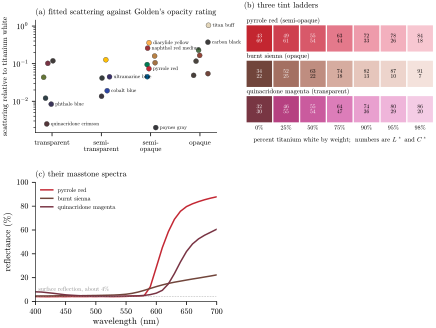
Figure 10. (a) How strongly each calibrated paint scatters green light, gram for gram, compared with titanium white, as the model works it out from measured tints, against Golden’s opacity rating [25]. The vertical scale is logarithmic: each labeled mark is ten times the one before. (b) Three paints of different opacity mixed with more and more white, computed with the model; the numbers on each swatch are its lightness \({L^{*}}\) and chroma \({C^{*}_{ab}}\). Pyrrole red only fades, while quinacridone magenta first gains color. (c) The measured masstone spectra of the three. The thin line near the bottom is the surface floor.
Adding white separates the two kinds. Pyrrole red, rated semi-opaque, is at its most vivid straight from the tube, and every addition of white makes it paler and duller (Figure 10(b)). Quinacridone magenta, rated transparent, starts dark and dull, grows more vivid with white up to a peak near one part white to two of paint, and only then fades. Burnt sienna, which Golden rates opaque but which scatters only a twentieth as much as the white, does a little of both. Section 3.4 explains the peak. The masstone curves in panel (c) show why. Pyrrole red’s particles scatter red light back out, and it reflects most of the red. Quinacridone magenta reflects no more than 61 percent even at the far red end, and across the green and most of the blue it sits on the surface floor, because the light there is absorbed before anything can send it back.
How well a layer hides depends on how far light gets into it before it is turned around. Once the layer is several times that distance thick, very little light reaches the ground and returns, and the ground is hidden. In titanium white the distance is a few thousandths of a millimeter, and a film a few hundredths of a millimeter thick hides [43]. In a phthalocyanine, light goes so far that a film would have to be absurdly thick to hide by scattering alone. It hides in masstone by absorbing nearly everything instead, so its masstone is near black [43]. The trade’s name for a paint’s ability to cover is hiding power, and absorption adds to it as well as scattering. A transparent paint hides well in the colors it absorbs and poorly in the colors it passes, so a glaze of phthalo blue over white hides the white in the red and shows it in the blue.
Scattering also depends on the binder and on how much of it there is. The same pigment scatters more in air than in oil or acrylic, because the mismatch of refractive index is larger: a dry pastel or an underbound, chalky paint is lighter and more opaque than the same pigment well bound, and a wetted pastel darkens as the liquid fills the air spaces [72]. When a paint has so much pigment that the binder can no longer fill the spaces between the particles, a point called the critical pigment volume concentration, air pockets appear in the film and scatter on their own, and the paint turns matte and opaque at once [2, 66]. The Golden Heavy Body paints are well short of that point, and the measurements here are of fully bound films.
A paint does not scatter the same amount at every wavelength, and that matters for mixing. White pigments scatter most at the blue end, which Section 3.7 takes up. Colored pigments tend to scatter most just past the long-wavelength edge of the colors they absorb, on the side toward the red, because a material’s refractive index changes fastest near the wavelengths it absorbs [43, 39]. Okumura saw the scattering change across the spectrum in his tint ladders of the Golden paints, most clearly for phthalo green [59]. The model lets each paint’s scattering vary across the spectrum, and without that it cannot reproduce the measured tints of the phthalocyanines.
Sources
[2] W. K. Asbeck and M. Van Loo, Critical pigment volume relationships, Industrial and Engineering Chemistry 41 (1949), 1470–1475.
[25] Golden Artist Colors, Inc., Heavy Body Acrylics: Pigment Detail Chart, https://goldenartistcolors.com, 2025.
[39] G. A. Klein, Industrial Color Physics, Springer Series in Optical Sciences 154, Springer, New York, 2010.
[43] R. Levinson, P. Berdahl and H. Akbari, Solar spectral optical properties of pigments, Part II: Survey of common colorants, Solar Energy Materials and Solar Cells 89 (2005), 351–389; the Lawrence Berkeley National Laboratory Pigment Database, https://coolcolors.lbl.gov/LBNL-Pigment-Database/database.html.
[59] Y. Okumura, Developing a Spectral and Colorimetric Database of Artist Paint Materials, M.S. thesis, Rochester Institute of Technology, 2005, https://repository.rit.edu/theses/4892.
[66] J. A. Seiner and H. L. Gerhart, Light scattering from microvoids: applications to polymer coatings, Industrial and Engineering Chemistry Product Research and Development 12 (1973), 98–109.
[72] S. Twomey, C. F. Bohren and J. L. Mergenthaler, Reflectance and albedo differences between wet and dry surfaces, Applied Optics 25 (1986), 431–437.