4.2 Vivid colors come from broad bands
A pure yellow or a pure blue, in the way painters use the words, would be a paint that reflects a single hue, and the best pigments are supposed to come closest. No paint does, and the best pigments are the ones that stray furthest. A vivid yellow reflects the whole long half of the spectrum. Of the light cadmium yellow medium returns, as the eye weighs it, about a third comes from wavelengths that look green on their own, a third from the yellow ones and a third from the orange and red. A surface that reflected only the yellow part of the spectrum would be no brilliant yellow. It would be a dark mustard, only about as light as a mid gray, and a surface that reflected only a sliver around the yellowest wavelength would be darker still, a brown. Yellow is light because it is broad, and the same holds, less dramatically, for every hue: to be bright a surface must reflect a wide band of wavelengths, and a wide band always takes in the neighboring hues.
The first step of Figure 29 cuts the spectrum into four bands and measures how much of the light cadmium yellow medium returns, as the eye weighs it, comes from each. The violet and blue supply almost nothing and the other three bands about a third each, so two thirds of what makes this yellow bright is light that would be called green or orange if it arrived alone. The second step computes the colors of imaginary surfaces that reflect one band completely and nothing else (the numbers for every band are in the math box at the end of this lesson). The yellow band of the spectrum gives the dark mustard, vivid but dark, since a yellow only as light as a mid gray no longer looks like a clear yellow. A surface that reflects every wavelength longer than \(500\,\mathrm{nm}\), from the green to the red end, is light and very vivid, and that is roughly what a cadmium yellow is.
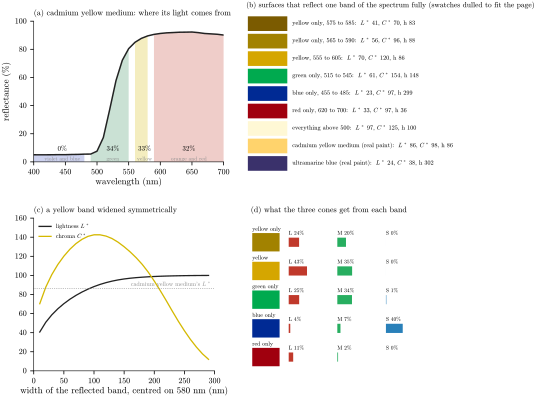
Figure 29. No pure hue. (a) Cadmium yellow medium’s reflectance, with the spectrum divided into four bands and the share of the light the paint returns, as the eye weighs it, that each band supplies. (b) Imaginary surfaces that reflect one band of the spectrum fully and nothing else, with their lightness, chroma and hue; the swatches are printed with their chroma reduced to what the page can show. (c) A band centered on \(580\,\mathrm{nm}\) widened on both sides: its lightness and chroma. (d) What the three kinds of cone receive from each band, as a fraction of what they receive from white.
The third step, in panel (c), starts from that sliver in the yellow, the brown, and widens it on both sides. As it widens the surface grows lighter, and it becomes as light as cadmium yellow medium only once the band is about a hundred nanometers wide, reaching from the green into the red. The chroma is highest at about that width too, and falls as the band goes on to swallow the whole spectrum.
How light a surface looks depends on how much light it returns, weighted by the eye’s sensitivity. That sensitivity is a broad hump centered in the yellow-green, so a surface can be light only by reflecting a good part of the hump, which means reflecting from the green through the orange. Chroma comes instead from the differences between the cone signals, and a narrow band gives large differences, so the yellow band of panel (b) is vivid for all its darkness. The colors that are both light and very vivid are the optimal colors of Section 1.8, the most vivid any surface can be at each lightness, and MacAdam showed that at high lightness they are broad bands of the spectrum [47].
The last step, panel (d), looks at the same thing from the side of the cones. The narrow yellow band and the broad yellow both excite the long-wave and middle-wave cones and leave the short-wave cones alone; the broad one simply excites them more. Yellow is the hue the eye gives to any light that drives those two kinds of cone together and leaves the third alone, whether that light is a narrow band near \(580\,\mathrm{nm}\) or the whole long half of the spectrum. The idea of a pure hue comes from the spectrum itself, where each wavelength has one hue and a narrow band of light can be intensely colored. It does not survive the move to surfaces, which must be broad to be bright, or to pigments. A pigment absorbs light by raising the energy of its electrons, and in a solid the vibrations of the molecules smear each of these absorptions into a broad band [57]. A painter who looks for a pure yellow is looking for a dark one.
Sources
[47] D. L. MacAdam, The theory of the maximum visual efficiency of colored materials, Journal of the Optical Society of America 25 (1935), 249–252; Maximum visual efficiency of colored materials, ibid. 361–367.
[57] K. Nassau, The Physics and Chemistry of Color: The Fifteen Causes of Color, 2nd ed., Wiley, 2001.