4.6 Munsell’s circle against the equal-spaced wheel
The artists’ wheel sets out twelve hues at equal steps of thirty degrees, with red, yellow and blue at the corners of a triangle and the greens, blues and violets filling the space between. The wheel calls these equal steps. Measured with the hue angle of CIELAB, which was designed to follow the eye, they are far from equal. The third of the wheel from red to yellow covers less than a fifth of the measured circle, and the third from yellow round to blue covers more than half. The wheel stretches the oranges and crushes the greens and blue-greens, and it puts blue and blue-violet a full step apart where their paints are close neighbors.
To check this with real paints, Figure 32(a) puts the calibrated paint nearest each of the wheel’s twelve names on an outer ring, at the wheel’s equal steps, and on an inner ring at the CIELAB hue of its tint. There is no calibrated orange, so two earths, red oxide and burnt sienna, stand in for red-orange and orange. Neighbors on the inner ring are anywhere from a few degrees to a quarter of the circle apart. The wheel holds red, yellow and blue a third of the circle from each other, while their paints sit much closer from red to yellow and much farther apart from yellow round to blue. Any other reasonable choice of paints gives the same picture, because the unevenness is in the wheel itself.
The twelve-hue wheel descends from the color circles of the eighteenth century, which arranged the painters’ three primaries and their mixtures symmetrically because symmetry was the point [41, 6]. Itten’s version, the one most art students learn, says plainly that it is built from three primaries by mixing, with the secondaries and tertiaries placed between them by construction [37]. Munsell set out in 1905 to make a notation in which equal steps would look equal, in hue, in value (his word for lightness) and in chroma. His circle has no primaries. He chose five principal hues with five intermediates between them, so that the circle could be divided by tens and so that hues opposite each other would mix to gray on a spinning disk, and divided it into forty steps in all [54, 55]. In 1943 a committee of the Optical Society measured the Munsell samples, smoothed their spacing against the measurements and the judgments of many observers, and published a corrected set of colors, the renotation, which the system has used since [58]. CIELAB was later designed with the Munsell spacing as one of its targets [62, 41], so the two should agree fairly well, and Figure 32(b) shows that they do.
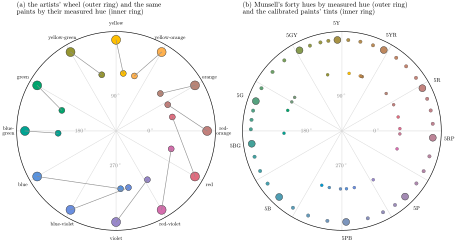
Figure 32. Two hue circles against measured hue. (a) The twelve names of the artists’ wheel at the wheel’s equal steps (outer ring), with the calibrated paint nearest each name, and the same paints at the CIELAB hue angle of their tints (inner ring). (b) The forty hue steps of the Munsell system at their CIELAB hue angles, computed from the 1943 renotation [58] at a Munsell value (lightness) of 6 and chroma of 6 under illuminant C, an older standard daylight, with the five principal and five intermediate hues named (outer ring), and the tints of the 21 calibrated paints with some chroma (inner ring); carbon black, Payne’s gray, titan buff and the two umbers are left out.
Panel (b) does the same for Munsell’s circle, placing each of its forty hues at the CIELAB hue of its Munsell sample, computed from the renotation. Its steps are not perfectly equal either. Some of the unevenness comes from CIELAB, whose hue angle follows judged differences of hue better in some regions than in others, the blues being the worst; this is one of the things the CIE’s formula for color difference of 2000 corrects [45, 23]. Still, Munsell’s largest step is less than twice its smallest, where the wheel’s largest is more than ten times its smallest (the math box at the end of this lesson lists them). The greens and blue-greens, which the wheel crowds into a quarter of its circle, get the third of Munsell’s that the eye gives them.
The inner ring of panel (b) shows where the calibrated paints fall: thick in the yellows and the reds, thick again in the blues, and thin in the yellow-greens and from blue-green round to blue, where there are few vivid single pigments. The wheel’s crowding of the greens may owe something to this, since a circle made from the paints at hand would have few greens to space out.
Munsell’s circle says how far apart two hues look, and says it well. A painter who wants to space hues evenly in a picture, or to judge how far a mixture has moved, should use it. The wheel is meant to say which paints mix to which, and it does that only in part: its three primaries are not the best three (Section 4.4), and its leans do not decide mixtures (Section 4.5), although its pairs across the center turn out to be fair mixing complements with these paints (Section 4.7).
Sources
[6] D. J. C. Briggs, Colour wheels, in The Dimensions of Colour, http://www.huevaluechroma.com/061.php, 2017.
[23] M. D. Fairchild, Color Appearance Models, 3rd ed., Wiley, 2013.
[37] J. Itten, The Art of Color, Reinhold, 1961.
[41] R. G. Kuehni, Color Space and Its Divisions: Color Order from Antiquity to the Present, Wiley, 2003.
[45] M. R. Luo, G. Cui and B. Rigg, The development of the CIE 2000 colour-difference formula: CIEDE2000, Color Research and Application 26 (2001), 340–350.
[54] A. H. Munsell, A Color Notation, Ellis, 1905.
[55] A. H. Munsell, Atlas of the Munsell Color System, Wadsworth-Howland, 1915.
[58] S. M. Newhall, D. Nickerson and D. B. Judd, Final report of the O.S.A. subcommittee on the spacing of the Munsell colors, Journal of the Optical Society of America 33 (1943), 385–418.
[62] A. R. Robertson, The CIE 1976 color-difference formulae, Color Research and Application 2 (1977), 7–11.