3.10 Darkening with black and with the complement
Black, the manuals say, deadens a color, while a complement or an earth darkens it and keeps it alive. The model can test this directly. Take a paint, darken it to a chosen lightness in three ways, with carbon black, with a complement that mixes with it to near gray, and with burnt umber, and compare the results.
The chroma comes out about the same whichever way the paint is darkened. Pyrrole red taken down to a fairly dark lightness ends at the same chroma, within a unit, whether it is darkened with black, with permanent green light or with umber, all at the same hue. Hansa yellow medium ends at the same chroma all three ways, and diarylide yellow and permanent green light come close to that; the recipes are written out in the math box at the end of this lesson. Adding white back to the darkened reds does not separate them either. In Figure 26(a) the three darkening lines of each paint lie close together. The one small exception is umber with the yellows, which keeps a few more units of chroma because umber is itself a dark yellow-brown.
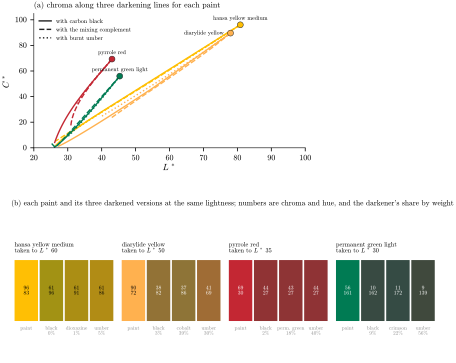
Figure 26. Darkening with black and with a complement. (a) Chroma against lightness as each of four paints is darkened with carbon black (solid), with a complement that mixes with it to near gray (dashed) and with burnt umber (dotted). The three lines of each paint nearly coincide. (b) Each paint and its three darkened versions at the same lightness, with chroma, hue and the darkener’s share by weight.
The hue does change. Black and the complement both turn the yellows toward green, by 8 to 14 degrees, while umber holds them within a few degrees of where they were; panel (b) of the figure shows the swatches side by side. The manuals are right that black changes a color, but the change is in hue: at any given lightness black leaves as much chroma as a complement or an earth would.
A colored paint reflects strongly in one part of the spectrum and weakly in the rest, and nearly all of its lightness comes from the bright part. Any darkener that brings it to a given lightness has therefore dimmed the bright part to about the same level. Chroma is the contrast between the bright part and the rest, and the rest was dark to begin with and can only get darker, so the chroma comes out about the same too. The three darkeners differ in which wavelengths they take the light from, and that decides the hue. Carbon black, as the model has it, absorbs more at the red end than at the blue, so it takes more red than blue from a yellow and turns it toward green. That is part of the olive that yellow and black are known to make; the rest is the eye’s habit of seeing any dark yellow as olive (Section 4.2). Umber absorbs most at the blue end and holds a yellow nearest its own hue.
The model’s black comes from Okumura’s ladder of carbon black in white, and that ladder cannot fully separate a black that absorbs more red from a white that returns more blue (Section 3.7), so the size of black’s turn toward green is less certain than the rest. The equal chroma does not depend on it, since it holds for three darkeners that absorb and scatter very differently. There are still good reasons to prefer a complement or an earth to black. The hue shift of black is usually unwanted, and umber avoids it, though a complement only sometimes does. And every black has an undertone of its own, bluish for carbon black and warmer for mars black, which shows in the mixture.
Back to top