2.1 Reflection, absorption and scattering
Light comes in tiny packets called photons, and a photon that reaches a layer of paint can do one of four things. It can bounce off the top surface without entering; this is the gloss and does not change the wavelength of the photon. Otherwise it goes in, where it meets pigment particles. A particle can absorb the photon, scatter the photon, or let the photon pass undisturbed. To scatter a photon is to send it off in a new direction. A photon that is left undisturbed by the pigment eventually reaches the substrate and is either reflected or absorbed by it. Absorption is what gives a pigment its hue: a pigment absorbs some wavelengths far more than others, and the ones it spares are the color it sends back. Scattering is what makes a paint opaque and what sends the colored light back to the eye. A pigment that scatters strongly is opaque; a pigment that scatters weakly is transparent and in a thick layer is dark, because the light that enters it is mostly absorbed before anything sends it back.
Figure 8(a) sketches the four ways light interacts with paint. The simplest case is a glaze, a thin layer of transparent paint over a white ground, or a watercolor wash on white paper. Nothing in the layer scatters much, so the light goes straight down to the ground and straight back up, and the paint acts as a colored filter. Each slice of the layer takes away the same share of whatever light reaches it, the way each pair of sunglasses in a stack dims what comes through by the same proportion. So the reflectance, the share of the light that comes back at a given wavelength, falls steeply with the first bit of pigment and more and more gently after that, as panel (b) shows. This is the Beer–Lambert law.
At the other extreme is a layer thick enough that the ground no longer matters, the masstone of Section 1.1. Inside it the light zigzags from particle to particle, losing some to absorption at every step, and the share that finds its way back out depends on a single number: how strongly the paint absorbs divided by how strongly it scatters. Color scientists write this ratio \(K/S\), with \(K\) for absorption and \(S\) for scattering, after the theory Kubelka and Munk published in 1931 [40]. A paint that absorbs twice as much and scatters twice as much reflects exactly the same, because its light is turned around twice as often, so each leg of its zigzag is half as long, and on each leg it loses the same share as before.
The curve in panel (c) turns \(K/S\) into reflectance, and it has a shape every painter knows from the palette. It leaves white nearly vertically: near white, the first trace of an absorbing pigment removes a large share of the light, and each later addition removes much less. It approaches black slowly, so once a mixture is dark, more black changes it little. The dots on the curve are tints of carbon black in titanium white. The first tenth of a percent of black dims the light inside the paint by about a tenth, while going from half black to pure black takes it only from 9 percent to 3. This steep start is the painter’s rule that a little black goes a long way in a tint. Here the reflectance inside the paint means what the paint sends back before the surface reflection is added, the subject of the next lesson.
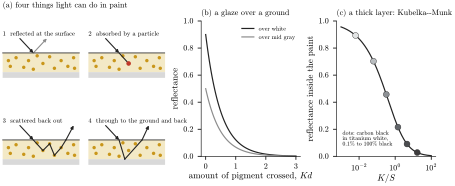
Figure 8. (a) The four things light can do in a layer of paint: reflect off the surface, be absorbed by a particle, be scattered back out, or pass through to the ground and back. (b) A glaze over a white ground and over a gray one. The horizontal axis is the amount of pigment the light crosses, its absorption times the thickness of the layer; the light comes back weaker the more pigment it crosses, falling fast at first and then slowly. (c) A thick layer: the light that comes back depends only on the paint’s absorption divided by its scattering, \(K/S\). The horizontal scale is logarithmic: each labeled mark is ten times the one before. The dots are tints of carbon black in titanium white, from 0.1 percent black to pure black, at \(550\,\mathrm{nm}\), computed with the model.
A particle scatters light because light bends, and partly reflects, wherever it crosses from one material into another, here from the binder into the pigment and out again. How much a material slows light is called its refractive index, and the bigger the mismatch between pigment and binder, the more sharply the light is turned. Scattering is mostly a function of the refractive index of the pigment relative to the binder and the particle size of the pigment. As for size, a given amount of pigment scatters most when its particles are a little under half the wavelength of the light inside the binder, and less when they are much smaller or much larger [50, 4]. Titanium dioxide is made at that size and has a refractive index of 2.7 against the binder’s 1.5, and no other white scatters as much [8]. A phthalocyanine has particles a third or less of the best size, and it absorbs so strongly that what little scattering its particles do is swamped [31]; it colors the binder much as a dye would.
A pigment brings two properties to a paint at every wavelength, how much it absorbs and how much it scatters, and both grow in proportion to the amount of pigment. Its hue comes from the pattern of its absorption across the spectrum: a yellow pigment absorbs the blue and violet and little else, a blue pigment absorbs the red and yellow. Its opacity comes from its scattering. A masstone shows only the ratio of the two, so a masstone alone cannot say how a paint will mix. The math box at the end of this lesson gives both laws and where they come from.
Sources
[3] R. S. Berns, Billmeyer and Saltzman’s Principles of Color Technology, 4th ed., Wiley, 2019.
[4] C. F. Bohren and D. R. Huffman, Absorption and Scattering of Light by Small Particles, Wiley, New York, 1983.
[8] G. Buxbaum and G. Pfaff (eds.), Industrial Inorganic Pigments, 3rd ed., Wiley-VCH, Weinheim, 2005.
[31] W. Herbst and K. Hunger, Industrial Organic Pigments: Production, Properties, Applications, 3rd ed., Wiley-VCH, Weinheim, 2004.
[39] G. A. Klein, Industrial Color Physics, Springer Series in Optical Sciences 154, Springer, New York, 2010.
[40] P. Kubelka and F. Munk, Ein Beitrag zur Optik der Farbanstriche, Zeitschrift für technische Physik 12 (1931), 593–601.
[50] G. Mie, Beiträge zur Optik trüber Medien, speziell kolloidaler Metallösungen, Annalen der Physik (4) 25 (1908), 377–445.