4.5 Color bias fails as a concept
The split-primary palette explains itself with the idea of color bias. Every paint is said to lean toward one of its neighbors on the wheel, a blue toward green or toward violet, a red toward orange or toward violet, a yellow toward green or toward orange, and the lean is supposed to decide its mixtures: a blue that leans toward green should make clean greens and dull violets. Section 3.8 tested the palette’s six paints and some of their relatives two at a time, and found the rule right for the six and wrong for several of the others. Here the idea itself is put to the test, on every calibrated blue, red and yellow at once.
For each paint the lean is the hue of its tint, the paint with enough white to bring it to a middle lightness, since a dark masstone hides its hue (Section 4.9). Each paint is then mixed in every proportion with a fixed partner, a yellow for the greens for example, and the chroma of the mixture that lands on a chosen green, orange or violet is recorded; the partners and the target colors are listed in the math box at the end of this lesson. Figure 31 plots the lean against the chroma. If the lean decided the mixtures, the points for each family would climb or fall in a line.
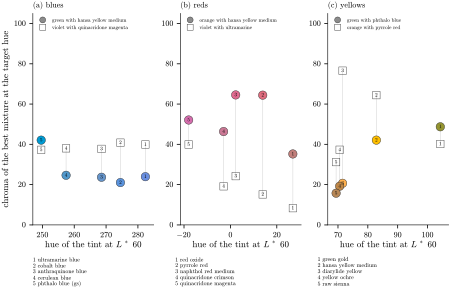
Figure 31. The lean of a paint against its mixtures, for the calibrated blues (a), reds (b) and yellows (c). Payne’s gray, which is nearly black, and burnt sienna, an orange between the reds and the yellows, are left out. Across: the hue of each paint’s tint at a lightness of 60 (or of its masstone, for the yellows lighter than that), which is its lean. Up: the chroma of the best mixture it makes with a fixed partner at a fixed hue and lightness, with filled circles for one secondary and open squares for the other. The numbers identify the paints in the keys below.
Only the yellows come close. Apart from the two earth yellows, their greens with phthalo blue fall and their oranges with pyrrole red rise as the lean moves from green toward orange, and Section 3.8 showed why: a yellow’s reflectance is a single edge, and where the edge falls sets both its hue and its greens. The blues follow the lean only roughly, with large differences between blues of nearly the same hue and almost none in their violets. The reds hardly follow it at all, although with five reds that test is thin. Each failure comes from something the lean leaves out, as the tests of Part 3 showed.
A lean is one number, the hue, and a mixture depends on a whole curve. A mixture of two paints of different hues, such as a green from a yellow and a blue, is vivid in proportion to what both reflect in the band of wavelengths that gives the mixture its hue. A blue’s hue is set largely by the balance between its blue reflectance and the tail it has into the red, which pulls it toward violet. Its greens are set by how much green light it reflects, which is a separate matter. Cobalt blue leans toward violet because of that red tail, and the tail has nothing to do with how much green it reflects, which is what decides its greens.
A rule that works for yellows, roughly for blues and not for reds is a correlation, one that holds when a pigment’s reflectance happens to be a single edge. The better guide is to read the curve, or, lacking the curve, read the paint’s lightness and chroma as well as its hue, and expect the middle of the spectrum to dominate any mixture across the circle [15].
Sources
[15] Color Nerd, Split-primary palettes miss this paint mixing insight, Color Wheel Wednesday, episode 29, video, 7 October 2026, https://www.youtube.com/watch?v=R0JkjnerdOw.